organiser · · By Simon Berriman, Founder of Caddie Live
Starting a Golf Society: The Complete Guide

Starting a Golf Society: The Complete Guide
Most golf societies start the same way: a group that has been playing together for a while, one person who keeps saying "we should make this a proper thing", and a summer where it finally happens. That person is usually the one reading this.
A society is not complicated. You need a handful of people who want to play regularly, a few decisions made once and written down, and a season that runs to a plan rather than a group chat. This guide takes you from "we should do this" to the end of your first season. If you already have a society and just need to run one day well, start with our guide to organising a golf society day. This is the piece before that one.
To start a golf society, get a reliable core group together, agree how membership and money will work, choose an organiser and treasurer, book a season of fixtures, decide your handicap and competition rules, and give members one place to register, pay and follow the results. You do not need a large committee or forty members to get started.
In this guide
- Get the founding group together
- Choose a name and decide how you'll run it
- Pick your officers
- Set the subs and the entry fees
- Build your first fixture list
- Handicaps for a mixed membership
- Running the day itself
- How the season ties together
- Your first-season timeline
Get the founding group together
You don't need forty members. You need eight to twelve people who will reliably turn up, because a society that can't fill three fourballs on a Saturday in May folds by August.
Start with the people you already play with, then ask each of them for one name. Be clear about the proposal: a fixed number of days a year, at a range of courses, with a competition running across them. That sentence filters out the people who only wanted a one-off day.
Have one conversation early that most new societies skip: who is this for? Low-handicappers chasing championship courses, or a laugh, a Stableford and a curry? Neither is wrong. Mixing them without saying so is how you lose half the group in year two.
Choose a name and decide how you'll run it
The name goes on the leaderboard, the trophy, the shirts and the website, so pick something you'll still be happy with in ten years. Place names and pub names age well; puns on a member's surname work until that member leaves.
Then decide on structure, and keep it light. A new society needs three things agreed and written down:
| Decision | What to write down |
|---|---|
| How you make decisions | The organiser decides the small stuff. The group votes once a year on the big stuff: subs, the number of fixtures, whether to allow guests. |
| Who can join, and how | Invite only, open to anyone who asks, or open with approval. Most societies start invite-only and loosen up once they trust the culture they've built. |
| What happens to the money | One person holds it, in a separate account or a clearly ring-fenced pot, and reports on it once a year. |
A one-page constitution covers all three and saves arguments later. It doesn't need to be a legal document. Our constitution guide and template is coming later this year and will link from here.
Pick your officers — and keep it to three
Committees kill new societies. You need three roles, and in year one two of them can be the same person:
- Organiser / secretary — books the courses, runs the fixture list, sends the messages, sorts the draw. This job makes or breaks the society, so give it to the person who actually wants it.
- Treasurer — collects subs and entry fees, pays the clubs, keeps a record. Make this a different person from the organiser if you can; two sets of eyes on the money is good hygiene even between friends.
- Captain — presents the prizes, makes the speech, breaks ties on rules questions. Rotate it yearly so everyone has something to aim at.
Whatever the titles, agree who can commit the society's money and who speaks for it to a club. And whatever you run the society on, give your co-organisers access to it from day one, so the society isn't sitting in one person's inbox.
Set the subs and the entry fees
Money is where new societies get awkward, so make the rules plain before anyone pays anything. Most societies run two layers:
- An annual subscription covering the fixed costs — trophies, the end-of-season meal, kit, a float for deposits. For a new society this is modest, in the tens of pounds. Its real purpose is commitment: someone who has paid for the year turns up.
- A per-event entry fee covering that day — green fee, food, prize fund — priced at cost plus a small buffer for no-shows, collected in advance, deadline enforced. "I'll pay you on the day" is how treasurers end up out of pocket.
Decide up front whether guests pay a premium and what the refund rule is when someone drops out after the club has your final numbers. Write both into the rules.
Collect the per-event money through something that shows you who has paid without checking a bank statement. Society Caddie lets you set an entry fee on any event and take payment by card — the money goes straight to the society's own Stripe account, and the roster shows who has paid alongside who has registered. Caddie Live provides the platform and takes a small fee per entry.
Build your first fixture list
A fixture list turns a group of mates into a society. Aim for six to ten events in year one, roughly monthly from spring to October, with the dates fixed before the season starts. Nobody can plan around "let's see who's free".
- Mix the courses by price and difficulty. A couple of aspirational days, a couple of cheap midweek ones, the rest in the middle.
- Fix a format for the season and vary the team game. Individual Stableford as the standing competition, a different team format on top each time. Our guide to golf day formats covers what suits a mixed field.
- Cap each event and run a waiting list. Your tee-time block sets the number. A waiting list is fairer than the organiser deciding who gets the last spot.
- Give the last event some weight. Make it the one where the order of merit is decided and the presentation happens, so the season builds to something.
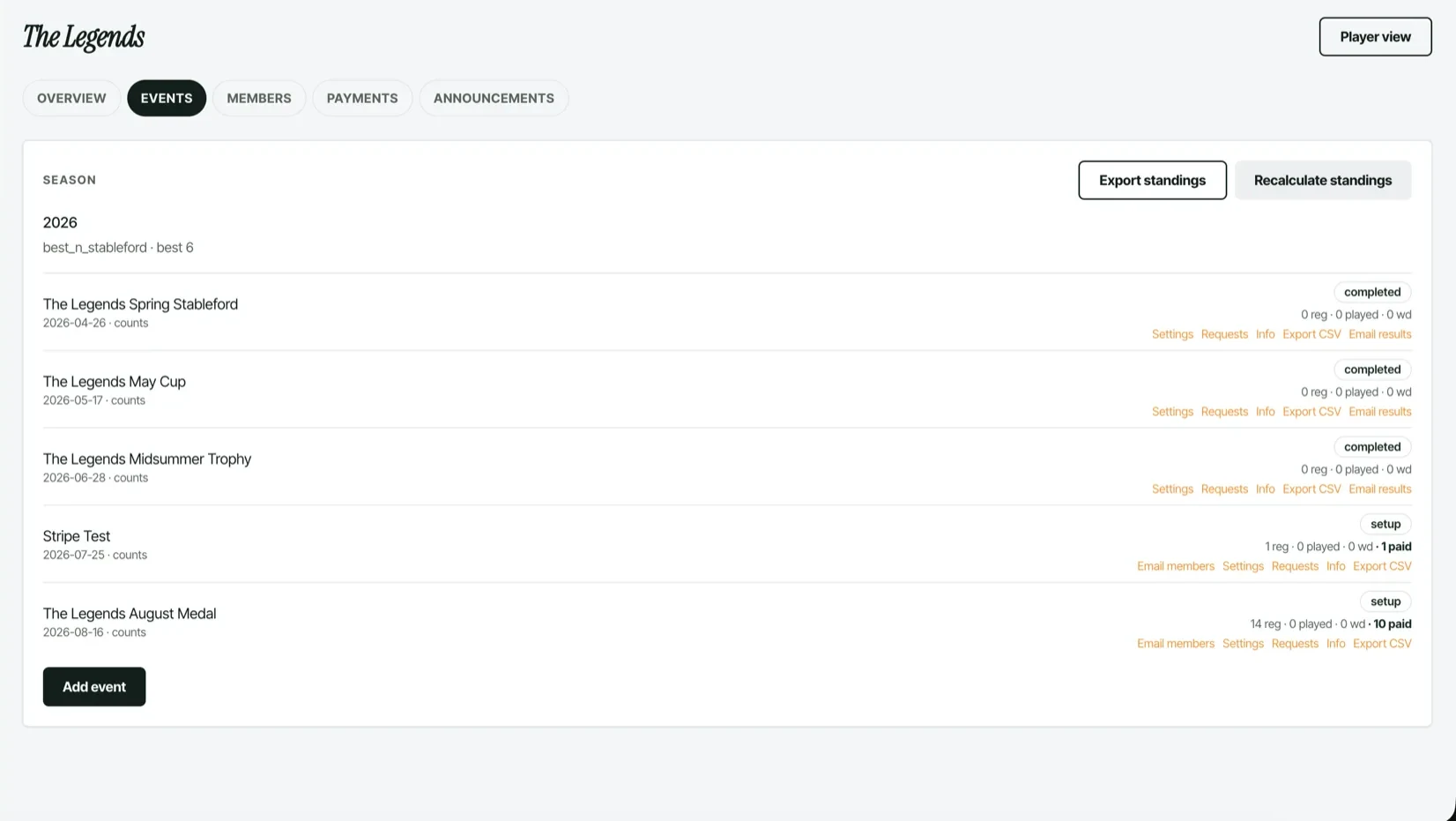
Publish the list once and treat it as the single source of truth. In Society Caddie every event you create sits inside the season, so fixtures, registrations and the waiting list live on one page rather than a pinned message that goes stale. Members register through a link, you see who is in and who has paid, and anyone over capacity is waitlisted and promoted automatically when a place frees up.
Ready to set your season up? Create your society, add the season and your fixtures, and share one link so members can register. Start your society free →
Handicaps for a mixed membership
This is the part new organisers worry about most, and it's simpler once you separate two questions.
First: what number is each member playing off? A society membership is almost always mixed. Some members belong to a club and hold an official WHS Handicap Index. Others have never had one. You need a consistent rule for both:
- Club members use their Handicap Index and are responsible for keeping it current.
- Non-club members need a working number. For an informal society, a playing number based on recorded scores is far more useful than asking someone what they think they play off. Caddie Live builds a CPI Handicap (Current Playing Index) for anyone who records their rounds in it, and it updates as they play. It is not an official WHS Handicap Index and won't be accepted for affiliated club competitions, but for an informal society it gives you a consistent, evidence-based playing number.
- A brand-new member plays off a provisional number for their first few events. Agree that and put it in the rules.
Members who want the official route without joining a club can use England Golf's iGolf in England; Scotland and Ireland have their own schemes. Our guide to getting an official golf handicap explains the options.
Second: how do you apply those numbers on the day? Convert each index to a Course Handicap for the course and tees you're playing, then apply your competition's allowance. The Rules of Handicapping recommend 95% for individual Stableford in fields of 30 to 100 players, and note that 100% is reasonable for smaller fields, which describes most new societies. Pick one, write it into the rules, and apply it identically to everyone, every time.
Doing that by hand for thirty players is the one genuinely fiddly job in society golf. Caddie Live works out each player's Course Handicap for the tees and applies your allowance across the whole field, so the numbers are ready before the first group tees off. Our guide to handicaps for mixed-ability golf days covers the detail.
Running the day itself
Every fixture is a golf society day, and we've written that up in full: one person in charge, money in advance, a mixed-up draw with ten-minute gaps, prizes that give the back-markers something to play for, and the prize-giving after the meal. Before your first event, read the complete society day guide, then how to run the draw and tee sheet and golf day prize ideas and on-course games.
One thing changes when you're running a season rather than a one-off: each day's result feeds the standings, so the scoring has to be right and it has to be quick. Scoring on the day runs on Caddie Live: players enter scores on their phones as they go, Stableford points and handicaps calculate as they play, and the live leaderboard updates on everyone's phone and on the clubhouse TV. Once the result is confirmed, it counts toward the season.
How the season ties together
Three things separate a society from a group that plays golf together.
Standings that update after every event. An order of merit — a season-long table built from each member's results — gives every fixture a stake beyond that day's prizes. Count each member's best N results rather than all of them, so a shocker in April doesn't end someone's season in May; six counting scores from eight to ten fixtures is a common balance. Put the rule and the tie-break in your constitution. Society Caddie keeps the season standings for you — each completed event's results feed the table, which by default counts each member's best six Stableford scores with tie-breaks on wins, best single score and events played.
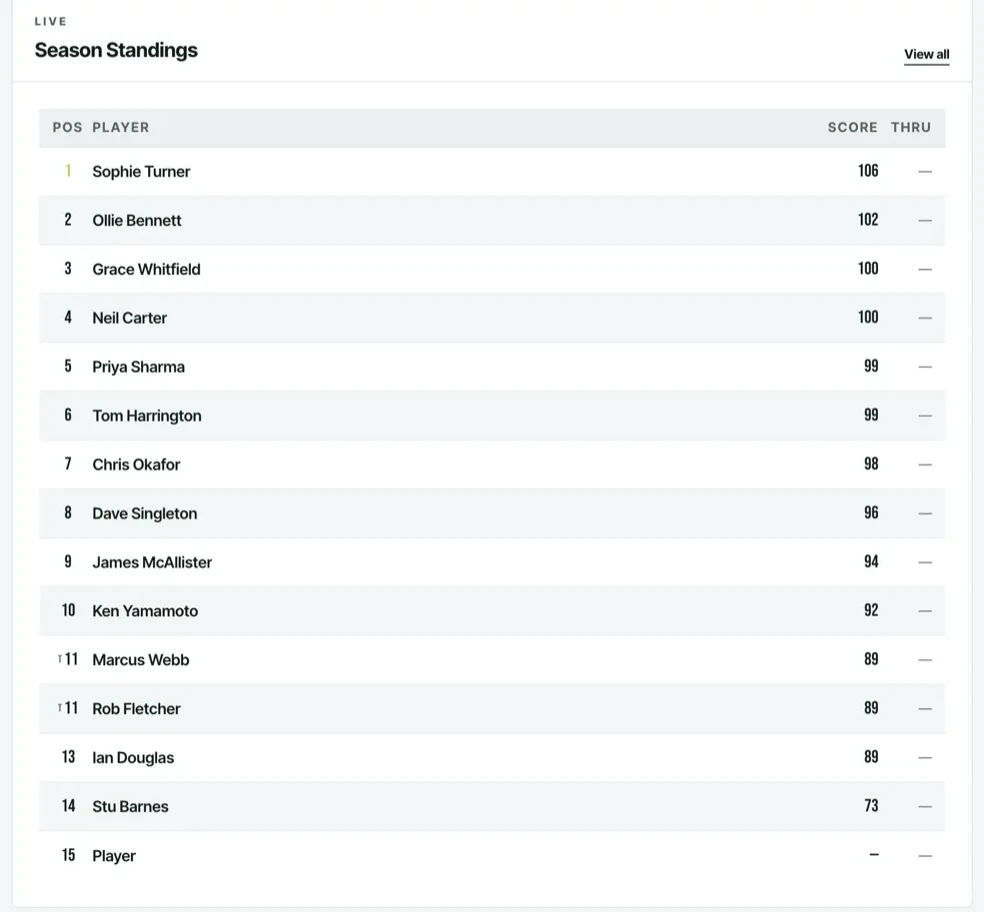
A place members can see it all. Fixtures, results, standings and announcements somewhere that isn't a chat thread. Every Society Caddie society gets its own public site with pages for fixtures, results, standings, announcements and members, and you choose what to publish and what stays members-only.
A presentation night. End the season with an evening: the order of merit trophy, the captain's prize, the wooden spoon, and the vote on next year's subs and fixtures while everyone is in the room. It's where the next season gets committed to.
Your first-season timeline
- Now: agree the founding group, the name, and the three written rules — decisions, membership, money
- 3–4 months before the first event: set subs and entry fees, set up the society's account or ring-fenced pot, book the fixtures and put the dates out
- 6 weeks before each event: open registration, take payment, chase the deadline
- Week of each event: publish the draw, confirm numbers with the club, set up live scoring
- Season end: presentation night, review the year, vote on subs and fixtures for next season
Set it up in one sitting
Everything above — members, season, fixtures, entry fees, handicaps, standings and the society website — is what Society Caddie was built to hold in one place. Create the society, add the season, put your fixtures in, share one join link, and your members register, pay and follow the standings themselves. Scoring on the day runs on Caddie Live, and each confirmed result rolls into the season without you touching a spreadsheet. It's free while we're in beta.
Get your members onto it from the first fixture. Once a society has watched the standings update the evening of a live-scored day, the spreadsheet doesn't come back.
Running a golf day?
Create your event free in Caddie Live and score it live. Create your event free