product · · By Simon Berriman, Founder of Caddie Live
Live Scoring vs Paper Cards: Why Your Golf Day Needs It
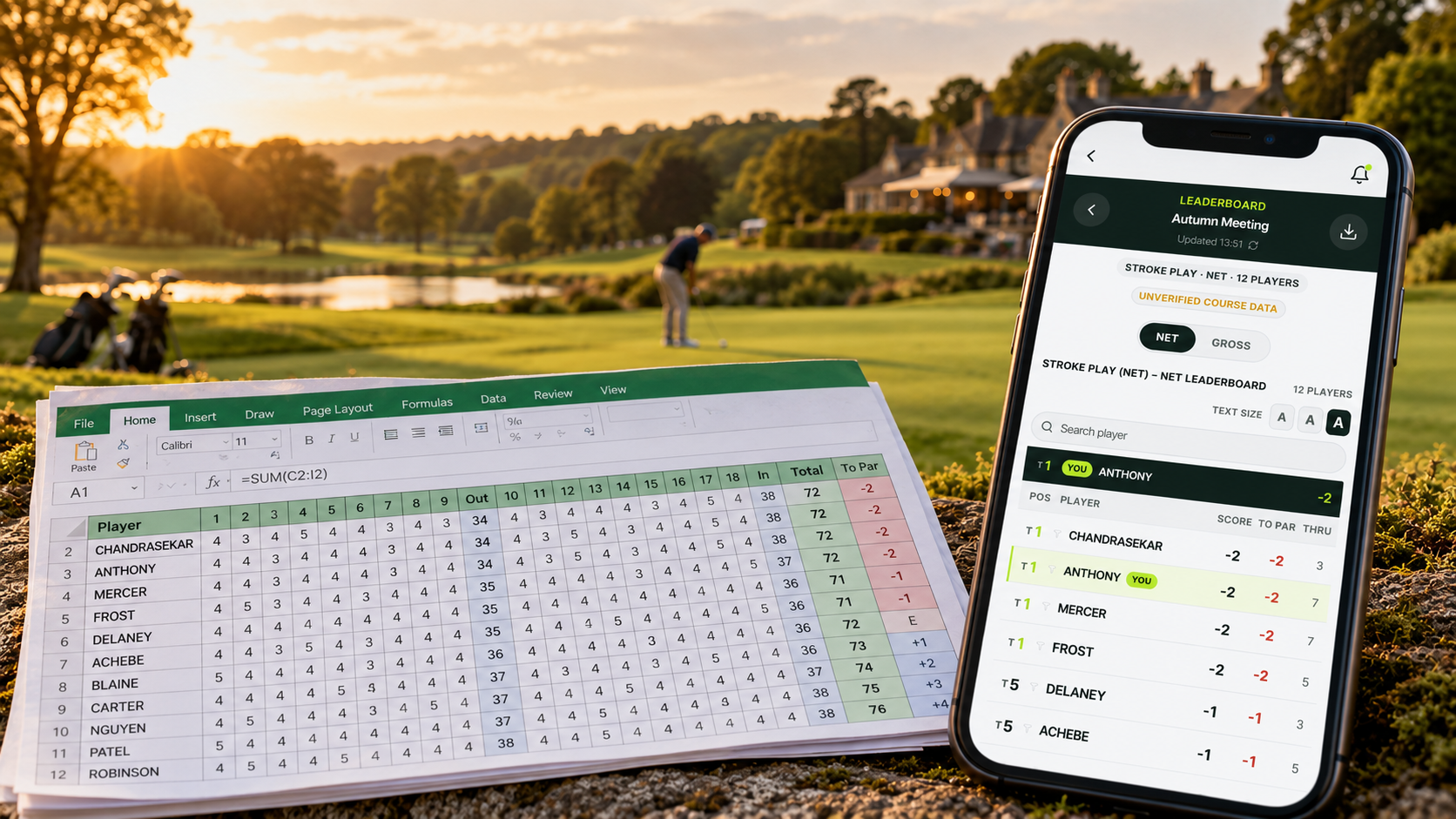
Live Scoring vs Paper Cards: Why Your Golf Day Needs It
Let's start by being fair to paper, because most of what gets written about golf scoring apps is not.
A paper card has never run out of battery. It does not need a signal, an account, or a software update the night before. Every golfer alive knows how to use one without being shown. It costs nothing, it works in the rain if you keep it in a pocket, and if you drop it in a bunker you can still read it. For a fourball on a Saturday it is close to perfect, and anyone who tells you otherwise is selling something.
So this is not an argument that paper is broken. It is an argument that paper stops working at a specific size and at a specific moment — and if you organise golf days, you have already met both.
Where paper actually costs you
Paper does not fail gradually. It fails at four particular points, and all four land on the organiser.
1. The dead half hour. The last group holes out and the day stops. Cards come in over fifteen or twenty minutes, you check them, you add up Stableford points, someone's card is unsigned, two cards disagree on the 14th. Meanwhile forty players stand around a bar asking who won. The best moment of the day — the prize-giving — is preceded by the worst, and the worst is entirely admin.
2. Arithmetic. Net scores and Stableford points on a mixed-handicap field mean a per-hole calculation, forty times over, done by a tired person who has also played eighteen holes. Mistakes happen. Most are caught. The ones that are not get discovered by the player who came second.
3. Disputes with nothing behind them. A paper card records what someone wrote down at the end of a hole. It does not record when they wrote it. If two cards disagree, you are adjudicating a memory, and the adjudicator is you, in a bar, with the prize table already laid out.
4. Nothing survives the day. This is the big one and the one organisers notice last. The cards go in a bag. Perhaps someone types the winners into a spreadsheet. The season has no standings until somebody builds them by hand, the order of merit is a separate job in itself, and a player who wants to know how they played at the same course last May has no way to find out. The day was recorded; the season was not.
If you run one golf day a year, none of this is worth changing. If you run a fixture list, points three and four compound every single time.
What live scoring changes
Live scoring means the score goes into a phone as the hole finishes, instead of onto a card to be processed later. Everything else follows from that one shift.
- The maths is done before you see it. Handicap allowances and Stableford points are applied per hole as scores arrive. There is nothing to add up and nothing to re-check.
- The result exists the moment the last putt drops. No gap, no queue, no calculator. You review the standings and go straight into the prize-giving.
- The leaderboard exists during the round. This is the part that surprises people. Paper cannot do it at all — not slowly, not badly, not at all. Players check their position at the turn, the groups start chirping at each other, and the day acquires a shape it did not have before. On a paid trip you can put the board on the clubhouse screen and let it run.
- The day becomes data. Every round is in each player's history, the society's results are already in a table, and the standings add themselves up as the season goes. The order of merit stops being a job.
That last point is why live scoring matters more to a society than to a fourball. A single day is a scoring problem. A season is a record-keeping problem, and paper has no answer to it.
Side by side
| Paper cards | Live scoring | |
|---|---|---|
| Needs a phone | No | One per group is enough |
| Works with no signal | Always | Scores save on the phone and sync later |
| Handicap and Stableford maths | By hand, after the round | Automatic, per hole |
| Leaderboard during the round | Not possible | Yes, on every player's phone |
| Clubhouse big screen | No | Yes, on a paid trip |
| Time from last putt to result | 15–30 minutes | Immediate |
| Record of the round afterwards | A card in a bag | Permanent, in every player's history |
| Season standings | Built by hand | Accumulate automatically |
| Cost | Pennies | Free to run a day — no player or round limit |
The honest downsides
Anyone who tells you live scoring has no drawbacks has not run a golf day with forty people on it. It has four.
Batteries. A round is four and a half hours and a phone that starts at 30% will not finish the day. This is the single most common cause of a scoring app going wrong, and it has nothing to do with the software. Tell your scorers the night before.
Signal. Plenty of good courses sit in a hole in the coverage map. Caddie Live holds scores on the phone when the connection drops and syncs them when it comes back, so the round is not lost — but the live leaderboard genuinely is not live while a group is off-grid, and you should say so rather than let people wonder why the board has stalled.
The one person who will not. Every society has them. The answer is not to convert them: nominate one scorer per group and let everyone else play golf. You only need eight or ten people on board for a field of forty.
It is one more thing to explain on the first tee. Thirty seconds, once, showing a scorer where to tap. But it is not nothing, and the first time you do it you should allow for it.
None of these are reasons not to switch. They are reasons to switch deliberately rather than on the morning of your biggest day of the year.
The hybrid most organisers land on
Almost nobody goes from paper to phones in one jump, and the people who try it on a captain's day usually regret the timing rather than the decision.
What works is this. Pick an ordinary fixture, not the showpiece. Run live scoring as the real system, and hand out paper cards as well for the first outing only. The scorers use the phone; anyone who wants a card keeps one. At the end you will find the paper cards unused in pockets, and that is the point — you have proved it to yourself at no risk, and at the next fixture you simply do not print them.
A reasonable first-time checklist:
- Set the event up the week before, not the morning of.
- Send the draw out in advance so nobody is learning two new things at once.
- Nominate one scorer per group and tell them the night before, including the bit about battery.
- Do the thirty-second demo on the first tee.
- Bring paper. Do not use it.
So, does your golf day need it?
If you run one informal day a year for twelve mates, honestly: no. Paper is fine and the overhead of changing anything outweighs what you would gain.
If you run a society with a fixture list, a mixed-handicap field, prizes that matter and any ambition of a season-long order of merit, then yes — and the reason is not that paper is hard. It is that paper produces nothing you can use tomorrow. Live scoring removes the admin from the end of the day and, more importantly, turns every fixture into a record that adds up to a season.
Scoring a golf day in Caddie Live is free, with no player limit and no round limit — 18 and counting formats, including Stableford, stroke play, match play, skins, better ball, scramble and greensome. If you want the step-by-step version of the setup, read how to set up a live leaderboard for your golf day. If you are planning the whole day from scratch, start with the complete golf society day guide.
Then pick an ordinary fixture and try it once.
Running a golf day?
Create your event free in Caddie Live and score it live. Create your event free