handicap · · By Simon Berriman, Founder of Caddie Live
How to Track Your Golf Handicap: A Complete Guide
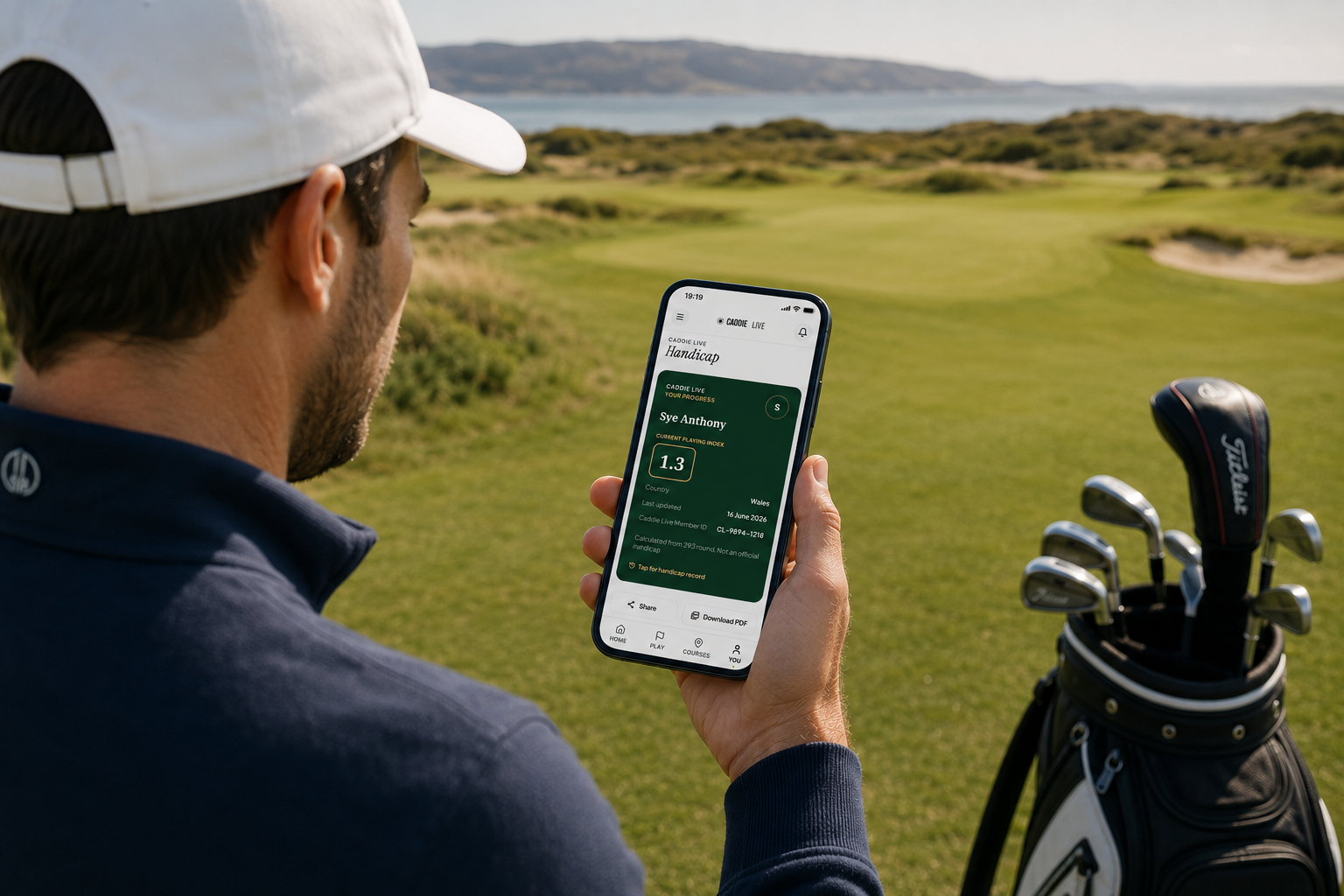
Tracking your golf handicap is one of the most motivating things you can do as a golfer. It turns a collection of good and bad rounds into a single number that measures how you're actually playing — so you can see yourself improve, enter competitions on a level footing, and settle exactly how many shots you get against your mates.
Whether you're chasing single figures or just want to know if you're getting better, it starts with tracking your handicap properly.
This guide explains what a handicap really is, the different ways to track one (official and app-based), how many rounds you need, and how to get started today.
What a golf handicap actually is
A handicap is a measure of your playing ability, expressed as a number. The lower the number, the better the golfer. Its clever trick is letting players of different standards compete fairly: a higher-handicap player receives more shots, so on any given day either player could win.
Under the World Handicap System (WHS) — the global standard used across the UK, Ireland, the US and most of the golfing world — your official number is called a Handicap Index: a portable figure, such as 18.0, based on the best scores in your recent scoring record. It reflects your potential rather than your average. (For the full mechanics, see our guide to how the World Handicap System works and how a handicap index is calculated.)
The important thing to know for tracking: your handicap is built from the scores you record. No scores, no handicap — which is why tracking is the whole game.
Handicap Index, Course Handicap and Playing Handicap
You'll come across three related numbers, and they each do a different job:
- Your Handicap Index measures your demonstrated playing ability and travels with you from course to course.
- Your Course Handicap adjusts that Index for the difficulty and par of the tees you're playing.
- Your Playing Handicap may then apply an allowance for the particular competition format.
That's why an 18.0 Handicap Index doesn't necessarily mean receiving exactly 18 shots in every round — the Playing Handicap is competition-specific, worked out from your Course Handicap using the applicable allowance. (Organising a mixed-ability event? Our handicaps for mixed-ability golf days guide covers applying these across a field.)
The two ways to track your handicap
There are two routes, and the right one depends on what you want it for.
1. An official WHS Handicap Index
An official Handicap Index is issued through an authorised golf body and is generally required for affiliated club competitions and other events played under WHS rules. You get one in one of two ways:
- Join a golf club. Membership of an affiliated club has traditionally been the route — you submit your scores and the club maintains your Index.
- Use a national non-member scheme. You no longer need to be a club member. In England, England Golf's iGolf gives eligible independent golfers an official Handicap Index for £47/year (via the MyEG app). In Scotland, the corresponding service is OpenPlay, provided through Scottish Golf. In the US, a Handicap Index comes through a club affiliated with an authorised golf association (many now online or "social" clubs). Other countries and jurisdictions have their own authorised routes, eligibility rules and prices, so check with the relevant national golf association. We cover this in detail in how to get an official golf handicap and whether you need to be a club member.
To establish an initial WHS Handicap Index, you must submit acceptable scores covering a total of 54 holes — any combination of nine- and 18-hole rounds. The rounds must meet the handicapping requirements in the country where they're played, and are normally played in the company of another person who can act as your marker. After that, your Index updates automatically as you post new scores.
2. A CPI Handicap with Caddie Live
You don't need to join a golf club before you can start tracking your handicap. Caddie Live automatically builds your CPI Handicap — Current Playing Index — from the rounds you record. It gives you a clear, current measure of your playing ability, shows how your golf is trending and provides a consistent handicap for casual rounds, society days and supported Caddie Live events. It updates as you add new rounds and sits alongside your scoring history and performance statistics.
Your CPI Handicap is designed for tracking progress and competing fairly in everyday golf. It is not an official WHS Handicap Index and may not be accepted for affiliated club competitions. But for golfers who mainly want to understand their game, play fairly with friends and make every round count, it's an easy place to start.
How to start tracking, step by step
However you go about it, the mechanics are the same:
- Record every round. Log your hole-by-hole or total gross score, the course you played, and the tees. Consistency matters more than remembering to only log your good ones — the system uses your best recent scores anyway.
- Make sure the course data is right. Your handicap calculation relies on the correct course, tees, Course Rating, Slope Rating and par — choosing the wrong tees can produce the wrong result. Tracking against real course data (not just "I shot 92") is what makes the number meaningful.
- Let the system calculate your handicap. Once you've recorded enough golf, your official provider can establish your WHS Handicap Index, or Caddie Live can begin building your CPI Handicap — a working number that updates with each new score.
- Keep it current. Post your rounds as you play them, so your number reflects your current form rather than a handful of isolated scores — and it's satisfying to watch it move.
Want to know your handicap? Record your rounds and Caddie Live builds your CPI Handicap automatically — with your stats and progress over time. [Track your handicap free with Caddie Live →]
Official or CPI Handicap — which do you need?
A simple way to decide:
- Play in affiliated club or official competitions? You need an official WHS Handicap Index — join a club or use a national scheme.
- Play casual rounds, society days and games with friends, and mainly want to track your progress? A CPI Handicap with Caddie Live is ideal, and you can always add an official one later.
Neither is "better" — they're for different jobs, and many golfers use both. Whether you have an official Handicap Index or a CPI Handicap through Caddie Live, tracking your handicap gives every round context.
What's a good handicap, and how fast can you lower it?
Once you begin tracking, the natural next question is where you stand. There's no single definition of a "good" handicap — it depends on your experience, age, ambitions and how often you play. We explore useful benchmarks in what is a good golf handicap, along with practical ways to improve it in how to lower your golf handicap.
Tracking alone won't lower your handicap, but it gives improvement a feedback loop: recording every round helps you see whether your scoring is moving in the right direction, and where practice may have the greatest impact.
Quick checklist
- Understand your Handicap Index — a portable number reflecting your potential
- Decide what you need it for: an official WHS handicap (affiliated club competitions) or a CPI Handicap with Caddie Live (progress, friends and Caddie Live events)
- For an official Index, join a club or use a national scheme (e.g. iGolf in England)
- Record every round with the correct course and tees
- You'll need 54 holes to establish an official WHS Index
- Keep posting scores so your number reflects your current form
Start recording your rounds and Caddie Live will begin building your CPI Handicap from your early scores. As your scoring record grows, it develops into a clearer picture of how you're currently playing — and gives you a number to beat next time.
Running a golf day?
Create your event free in Caddie Live and score it live. Create your event free